Coinsnap Taxes: How to Generate Your Crypto Tax Report
Every Bitcoin payment received or disposed of through Coinsnap creates taxable events. As an EU-based Bitcoin payment service, Coinsnap operates within a growing EU regulatory framework — making accurate tax records more critical than ever. CoinTracking imports your Coinsnap CSV export, calculates gains and income, and generates a compliant tax report for your country in minutes.

How to Import Your Coinsnap Transactions into CoinTracking
Watch how to export your Coinsnap transaction history as a CSV file and import it into CoinTracking to generate your complete crypto tax report.
Start Your Free Coinsnap Import- Every Bitcoin transaction, disposal, or business receipt processed through Coinsnap is a potential taxable event in most jurisdictions. Capital gains tax and income tax may both apply depending on how you use Coinsnap and your country of residence.
- CoinTracking imports Coinsnap transactions via CSV export: go to Finances → Reports in your Coinsnap account, select your time period, and download the CSV. Upload it directly to CoinTracking and your full transaction history is processed automatically.
- Transferring Bitcoin between your own wallets or accounts is generally not a taxable event. Simply holding Bitcoin is not taxable until you dispose of it.
- Under DAC8, EU crypto platforms are required to report user transaction data to national tax authorities. As an EU-based Bitcoin payment service, Coinsnap operates within this growing reporting framework — making accurate, voluntary tax disclosure more important than ever.
Coinsnap and Your Tax Obligations
Coinsnap is a German Bitcoin payment processor operated by Coinsnap GmbH. It enables merchants to accept Bitcoin payments — both on-chain and via the Lightning Network — in online shops, on websites, and at point-of-sale. Coinsnap supports a wide range of e-commerce platforms including WooCommerce, Shopify, and Shopware, and provides payment tools for any web project.
All Bitcoin received or disposed of through your Coinsnap account may generate taxable events. Whether you receive Bitcoin as a merchant payment, convert it to fiat, or hold it as an asset, each event must be reported to your tax authority.
CoinTracking supports Coinsnap via CSV import:
- Log in to your Coinsnap account and navigate to Finances → Reports
- Select the time period you want and click Download CSV
- Upload the CSV file to CoinTracking via the Coinsnap import page
- All transactions in the export are processed automatically

Crypto Tax Basics: What Coinsnap Users Need to Know
Coinsnap serves merchants and Bitcoin users across the EU and beyond. As an EU-based service, it operates within a framework of growing tax transparency requirements. The core principles below apply broadly — always verify the specifics with your local tax authority or a qualified tax advisor.
Every disposal is a taxable event
In most EU countries, selling, swapping, or otherwise disposing of Bitcoin triggers capital gains tax. The gain or loss equals the difference between your proceeds and your cost basis (the value at the time you received the Bitcoin, including any fees). If you are a merchant, the Bitcoin's value at the time of receipt is your cost basis. Tracking this accurately across all your Coinsnap transactions is essential for a correct tax report.
DAC8 and EU reporting requirements
The EU DAC8 directive requires crypto platforms operating in the EU to report user transaction data — including payment amounts and proceeds — to national tax authorities. EU-based services like Coinsnap are part of this evolving reporting landscape. This means your Bitcoin payment activity may increasingly be visible to your country's tax office, regardless of whether you file a tax return. Ensuring your declared income matches what is reported is critical.
Business income from Bitcoin payments
If you use Coinsnap as a merchant to receive Bitcoin payments for goods or services, those receipts are typically treated as taxable business income in the year received. The applicable tax treatment depends on your country — some jurisdictions treat this as ordinary business income, others may apply capital gains rules on subsequent disposals. CoinTracking automatically categorises these events in your tax report.
Coinsnap Taxes by Country
Crypto tax rules differ across Europe. Below are the key rates, deadlines and rules for the countries where CoinTracking users are most active.
 Germany
- Disposal tax: Personal income tax rate (up to 45%); gains are tax-free if held longer than 1 year (Haltefrist)
- Annual exemption: Gains up to €1,000/year are tax-free
- Cost basis: FIFO per wallet
- Authority: Finanzamt
- Forms: Anlage SO
 Austria
- 27.5% capital gains tax: Since March 2022, crypto is taxed like shares — a flat 27.5% KESt applies to gains
- Old coins grandfathered: Crypto acquired before 28 February 2021 is tax-free on disposal
- Business income: Professional trading activity may be taxed as business income at progressive rates
- Authority: Finanzamt Austria. Report via Einkommensteuererklärung (E1 / E1kv)
 Switzerland
- No capital gains tax: Capital gains from crypto are generally tax-free for private investors
- Wealth tax applies: Crypto holdings are subject to annual cantonal wealth tax; declare holdings on 31 December
- Professional traders: Frequent trading classified as business activity is taxed as ordinary income
- Authority: Cantonal tax authority. Report in Steuererklärung
 Netherlands
- Box 3 wealth tax: Crypto is taxed as notional capital income under Box 3. Tax is levied on a deemed return on assets, not on actual gains realised from trades.
- No capital gains tax on disposal: Unlike Germany or the UK, the Netherlands does not impose CGT on individual crypto trades.
- Box 1 for professional traders: If trading constitutes a business activity, profits may be taxed as ordinary income under Box 1 at progressive rates up to 49.5%.
- Authority: Belastingdienst
- Form: IB (Inkomstenbelasting) annual return
 Belgium
- Normal management gains: Tax-free for private investors whose activity is considered normal portfolio management
- Speculative/professional gains: Taxed as miscellaneous income at 33% (speculative) or at progressive income tax rates (professional)
- Authority: SPF Finances / FOD Financiën
- Form: Tax-Box II (diverse income) in the annual tax return
 France
- Flat 30% tax (PFU): Gains from crypto disposals are subject to the prélèvement forfaitaire unique — 12.8% income tax + 17.2% social charges
- No exemption for holding period: Unlike Germany, there is no tax-free threshold after 1 year
- Professional traders: High-frequency trading may be classified as BNC (non-commercial income) at progressive rates
- Authority: DGFiP. Declare via Formulaire 2086
 Spain
Spain
- Savings income (IRPF): 19% up to €6,000; 21% up to €50,000; 23% up to €200,000; 27% up to €300,000; 28% above
- Foreign crypto disclosure: Modelo 721 required if portfolio exceeds €50,000 abroad
- Authority: Agencia Tributaria (AEAT)
- Forms: Modelo 100 (IRPF), Modelo 721
 Italy
Italy
- Flat rate: 26% on gains exceeding €2,000/year (from 2023)
- Foreign holdings disclosure: Quadro RW required if portfolio exceeds €15,000
- Authority: Agenzia delle Entrate
- Forms: Quadro RT (gains), Quadro RW (foreign holdings)
 United Kingdom
- Capital Gains Tax: 18% (basic rate) or 24% (higher rate) from October 2024
- Annual exempt amount: £3,000 (2024/25 onward)
- Cost basis: Section 104 pool (HMRC rules)
- Authority: HMRC
- Forms: Self Assessment SA100, SA108
Tax rules change frequently. This overview is for general information only and does not constitute tax advice. Consult a qualified advisor for your specific situation.
Are Coinsnap Transactions Taxable?
In most EU jurisdictions, crypto is treated as an asset: disposing of it triggers capital gains tax. Use this as a starting reference — exact rules vary by country.
Taxable Events
- Selling Bitcoin received via Coinsnap for fiat
- Swapping Bitcoin for another crypto asset
- Using Bitcoin to pay for goods or services
- Receiving Bitcoin as a merchant payment (business income)
Not Taxable
- Buying and holding Bitcoin
- Transferring Bitcoin between your own wallets
- Depositing fiat to Coinsnap
- Receiving Bitcoin as a personal gift
Tax treatment varies by country. CoinTracking applies the rules for your selected jurisdiction automatically.
How to Calculate Your Coinsnap Taxes
Even occasional Coinsnap users can accumulate dozens of taxable events per year — each Bitcoin payment received, converted, or disposed of needs to be tracked with its correct cost basis, value at receipt, and any subsequent gain or loss.
CoinTracking imports your complete Coinsnap transaction history via CSV export, applies your chosen cost-basis method (FIFO, LIFO, HIFO, and others), calculates gains and losses for every disposal, and separates business income from capital gains in your final report.
The result is a jurisdiction-specific tax report — PDF or Excel — that your accountant or tax authority will accept, with a full audit trail for every transaction.

How to Import Coinsnap into CoinTracking
Three steps to import your Coinsnap data and generate your tax report.
- 1
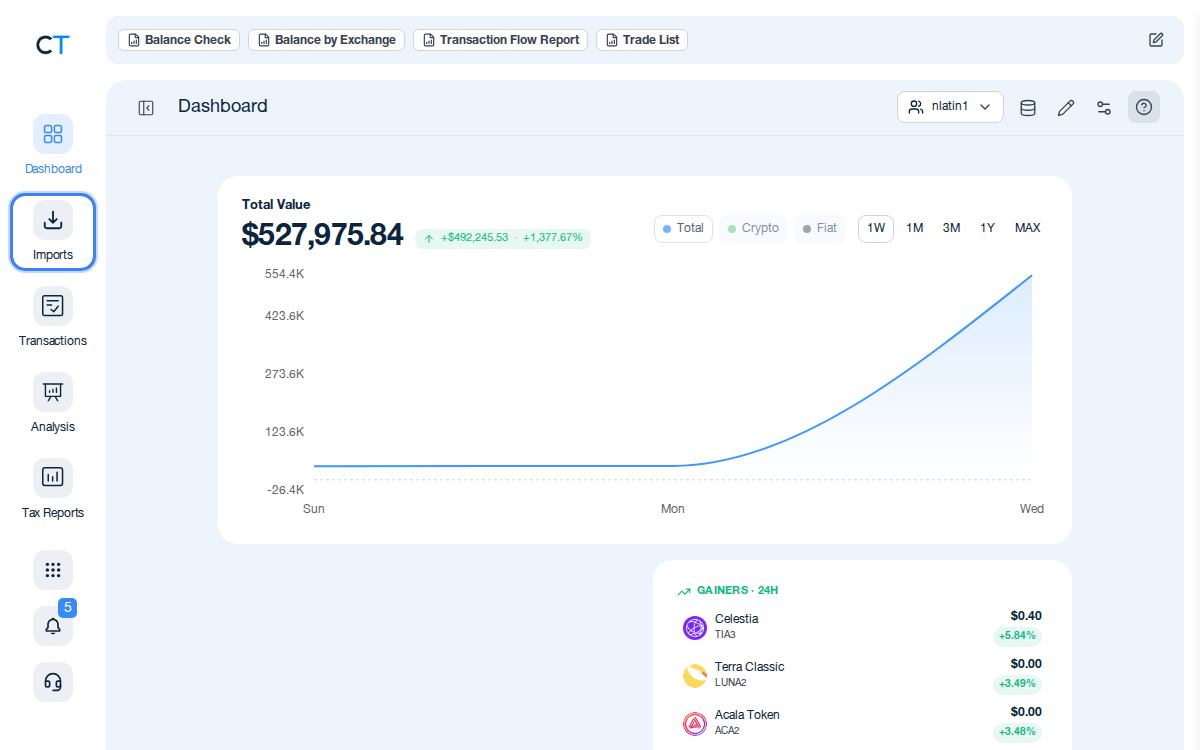
Log into CoinTracking and open Imports
After logging in, click the Import icon in the left navigation. This is where you connect all your exchanges, wallets and blockchains.
- 2
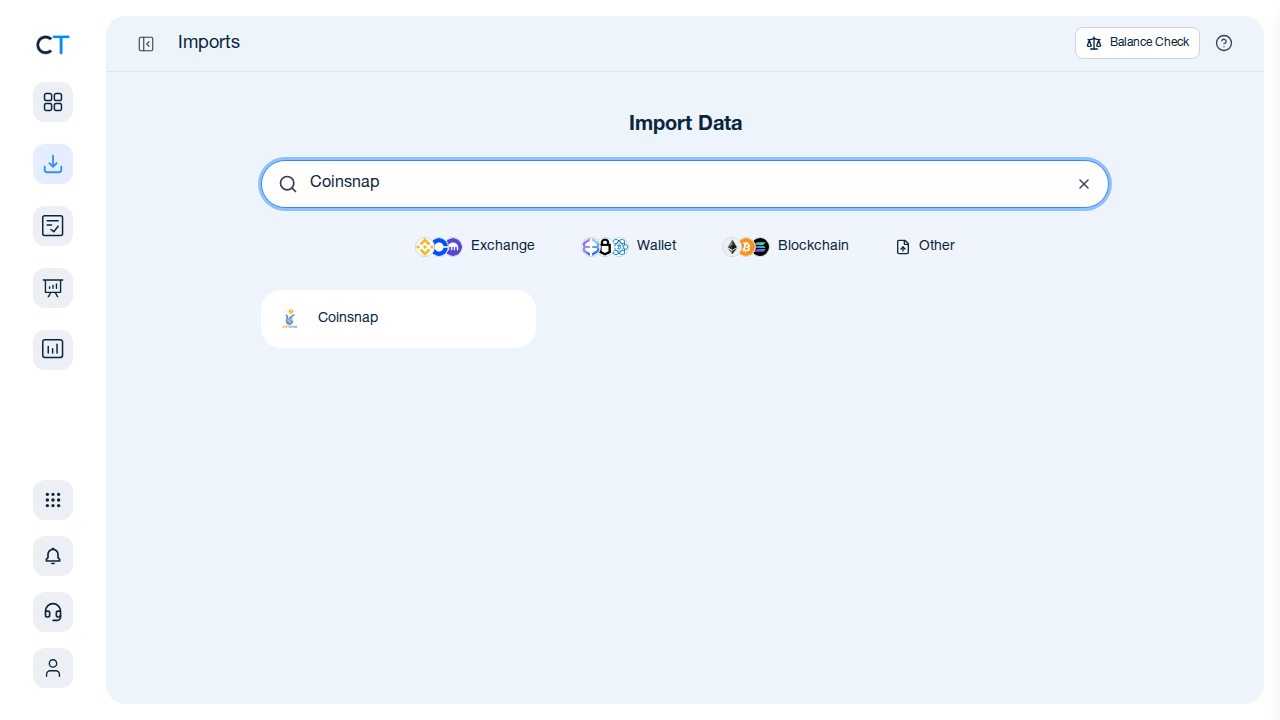
Search for Coinsnap in the import list
Type "Coinsnap" in the search field. CoinTracking will show the Coinsnap import option — click it to open the import page.
- 3
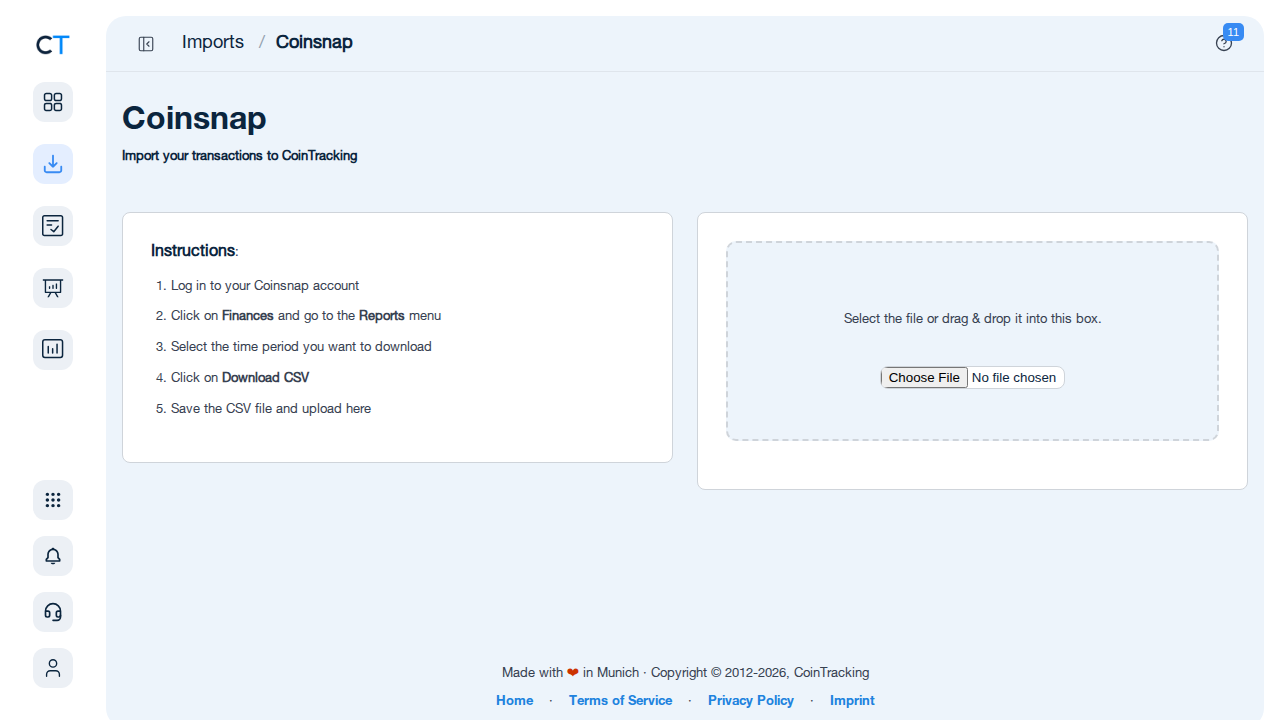
Upload your Coinsnap CSV export
In your Coinsnap account, go to Finances → Reports, select your time period, and click Download CSV. Upload the file on the CoinTracking Coinsnap import page. All transactions will be imported automatically.
"CoinTracking can handle just about any complex transaction you can throw at it and the automation is a real lifesaver. Of all the tax software tools we've reviewed, CoinTracking is the most detail-oriented and has more accuracy checks in place than the competition."

How to Create Your Coinsnap
Tax Report with CoinTracking
Three steps from CSV export to a tax report your accountant will accept.

Export and import your Coinsnap data
In your Coinsnap account, go to Finances → Reports and click Download CSV for your chosen time period. Then search for "Coinsnap" in CoinTracking's import section and upload the file. All transactions are processed automatically.

Review your transactions
Open Reports → Validate Transactions. CoinTracking flags missing cost basis entries, duplicate imports and price gaps so your final report is accurate.

Generate and export your tax report
Select your country and tax year. CoinTracking generates a report formatted for your jurisdiction: PDF or Excel, ready to file or hand to your accountant.



No. Coinsnap does not generate a ready-to-file tax report. It allows you to export your transaction history as a CSV file from the Finances → Reports section of your account. You can upload that CSV directly into CoinTracking, which then calculates your gains, losses, and income and generates a compliant tax report for your jurisdiction.
Log in to your Coinsnap account and navigate to Finances. Go to the Reports menu, select the time period you want to download, and click Download CSV. Save the file and upload it to CoinTracking via the Coinsnap import page. CoinTracking will process all your transactions automatically.
Yes. Every disposal, swap, or use of Bitcoin processed through your Coinsnap account may be a taxable event. If you are a merchant receiving Bitcoin payments, those receipts are typically treated as taxable business income at the time of receipt. Capital gains tax may also apply when you later dispose of the Bitcoin you received. Tax treatment varies by country — consult a qualified advisor for your specific situation.
DAC8 is an EU directive that requires crypto platforms operating in the EU to report user transaction data to national tax authorities. As an EU-based Bitcoin payment service, Coinsnap operates within a regulatory environment where reporting requirements for crypto businesses are growing. This makes accurate, voluntary disclosure of your crypto income more important than ever.
EU-based crypto platforms are increasingly subject to DAC8 reporting requirements, which oblige platforms to share user transaction data with national tax authorities. While the precise obligations for each platform depend on their regulatory classification, the overall direction in the EU is toward greater transparency. You remain personally responsible for declaring your income and gains from Coinsnap transactions. CoinTracking helps you produce a complete, accurate tax report for any jurisdiction.
CoinTracking supports the Coinsnap CSV format directly, so your import is straightforward. Once your transactions are in, CoinTracking calculates gains and losses using FIFO, LIFO, HIFO, and other cost-basis methods, generates country-specific tax reports (including Anlage SO for Germany), and maintains a full audit trail. Whether you use Coinsnap as a merchant or for personal Bitcoin management, CoinTracking turns your raw export into a tax report ready for your accountant or tax authority.
Start Tracking Your Crypto Taxes Today
Experience why 2.2 million users trust CoinTracking — sign up today for a seven-day free trial!